Case study
The Trailblazer for Recycling and Clean Energy
Fast-tracking Australia's net zero with new partnership models
Overview
The Trailblazer for Recycling and Clean Energy (TRaCE) unites Australia’s leading research institutions and industry innovators to accelerate the transition from laboratory breakthroughs to large-scale commercial adoption. Backed by the Australian Government, UNSW, the University of Newcastle, and having supported 120+ companies to date, TRaCE is building the foundation for a globally competitive clean-energy and recycling sector.
Snowmelt was engaged to help TRaCE build a shared frame of reference between academia and industry, enabling better connections, collaboration, commercialisation, and investment.
By articulating the Trailblazer model and visualising how TRaCE is connecting research and market needs, the work helps position the program as a leader in new collaboration patterns and a more coordinated Australian innovation ecosystem.
The challenge
Australia excels at generating new ideas but continues to lag in commercialising them. The Trailblazer model was created to change that, exploring new ways and incentives for universities and industry to work together differently and bring technologies to market faster.
The challenge was systemic: enabling diverse stakeholders - universities, investors, SMEs, and major industry sponsors - to engage in new collaborative R&D models, investment and support mechanisms. TRaCE needed a way to identify and bridge the gaps between the lab and the market and to demonstrate how new innovation models could accelerate commercialisation.
Beyond technology, the challenge was also narrative: How could TRaCE help people see and talk about these new ways of working, especially when many of the same stakeholders reappear across sectors and technologies? How might intangible collaboration, support structures and evolving partnerships and a coordinated ecosystem, be made visible to reinforce new patterns of engagement and inclusion, particularly for the emerging clean energy and recycling sector? How could the TRaCE leadership team make sense of the growing complexity of multi-pronged, intertwined and multidisciplinary initiatives? How could the evolution of the interventions, their socio-economic impact, and (un)expected outcomes be tracked and visualised - especially over time?
“I have never seen a representation of the evolution of an RD&I eco-system map like this. We can have better conversations with our stakeholders and demonstrate the impact of our work and approach.”

What we did
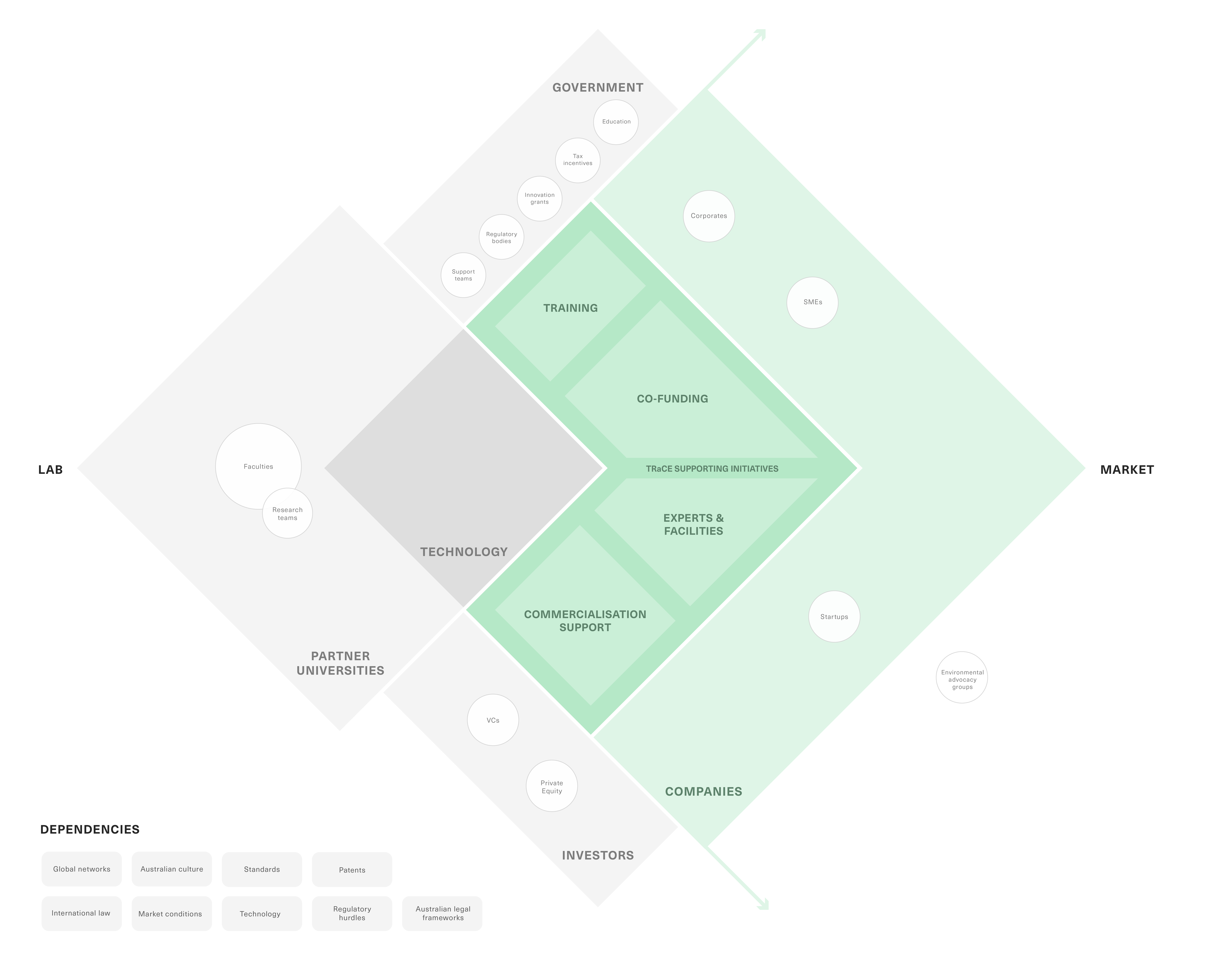
Snowmelt worked with the TRaCE team to understand how relationships between academia and industry were forming, and how the TRaCE model could address the gaps in collaboration. Through interviews and iterative system mapping, we articulated how TRaCE’s ecosystem operates and how research could connect more effectively to market needs.
Grounded in TRaCE’s transformation theory, the process combined multiple perspectives into a single shared representation of the ecosystem - a high-fidelity, data-driven artefact that enables shared understanding, storytelling, analysing, and strategic decision-making.
Key activities
- Conducted interviews with the TRaCE program team and key collaborators to understand how stakeholder relationships were forming between industry and academia, and how TRaCE was making sense of its role within that system.
- Mapped the ecosystem iteratively from multiple perspectives using different organising principles, grounded in the TRaCE’s’s transformation theory to explore how research connects to market needs.
- Developed a high-fidelity interactive system map that integrates data from supporting initiatives, interventions for change, technologies, research projects, and partners, creating a tangible artefact for shared understanding, storytelling, and strategic decision-making.
Outcomes
195 entities & 214 contracts mapped
Developed a shared frame of reference
Shaped the intervention infrastructure
Project Insights
- A shared story matters. Seeing how the ecosystem fits together allows people to understand their role, identify opportunities, and make collaboration tangible.
- Timing is everything. The representation of the system evolved as TRaCE’s work unfolded, showing that impact emerges through responsiveness to real system needs.
- Responsiveness creates momentum. By visualising where interrelatedness and gaps exist, along with impact modelling data, TRaCE can now focus investment and interventions where they are needed and matter most, accelerating commercialisation and connection across the ecosystem.
.jpeg)

.png)

